
Does light therapy work for seasonal affective disorder? Yes, and unusually for this site, the evidence is genuinely good rather than merely promising. Pooled across 21 randomised trials, bright light therapy significantly outperformed control treatments, and reviewers now describe it as a first-line non-drug option. What matters is getting the light, the timing and the dose right, because most people who say it did nothing were doing one of those wrong.
We spend a lot of time here explaining that a popular remedy does less than claimed. This is the opposite case, so it is worth saying plainly.
At a Glance
| Does it work | Yes. 21 trials, 1,037 people, significantly better than control |
| Standard dose | 10,000 lux for about 30 minutes |
| When | Within an hour of waking. Later can backfire |
| Which light | White came out best in a 2025 network analysis |
| How long until it helps | Often within a week or two, not the first morning |
| Check with a doctor first if | You have bipolar disorder, an eye condition, or take photosensitising medication |
What SAD Actually Is
Seasonal affective disorder is depression that follows a seasonal pattern, most often starting in autumn and lifting in spring. It is a recognised diagnosis, not a figure of speech for finding January miserable.
What marks it out from depression at other times of year is the shape of the symptoms. Many people sleep more rather than less, eat more rather than less, crave carbohydrates, gain weight and feel physically heavy and slowed down. That pattern is worth knowing, because it is the opposite of what people expect depression to look like, and it is part of why SAD goes unrecognised.
Milder versions, often called subsyndromal SAD or the winter blues, are far more common than the full diagnosis. The practical advice below applies either way, though how much you need depends on how badly it affects you.
What the Research Shows
A 2024 network meta-analysis in the Journal of Affective Disorders pooled 21 randomised controlled trials covering 1,037 participants. Phototherapy came out significantly more effective than the comparison treatments, and the authors concluded it is a promising first-line non-pharmacological treatment for SAD, well tolerated and with a meaningful improvement in mood symptoms.
They were honest about the limits too, describing the therapeutic effects as mild to moderate and noting that the overall quality of the evidence is not high. That is a fair description. It is a real effect in a field where many trials are small and blinding is genuinely difficult, since you cannot easily give someone a convincing placebo bright light.
A 2024 systematic review in the Journal of Psychiatric Research puts it in context: bright light therapy and medication are the current first-line treatments, with lifestyle changes as useful additions rather than replacements.
Which colour of light
Worth knowing before you buy, because shops push blue-enriched lamps hard. A 2025 network meta-analysis compared wavelengths across 17 studies and 773 patients. White light came out most effective, followed by green, then blue, then red. The same analysis found usual care outperformed green light.
So a standard full-spectrum white 10,000 lux box remains the sensible default, and the blue light premium is not clearly buying you anything.
Dawn simulators
These wake you with a light that brightens gradually, imitating sunrise. A head to head trial found dawn simulation reduced depression scores by a similar amount to bright light, 42% against 44%, with patient preference almost evenly split.
One nuance from that study is useful: people with more severe symptoms tended to do better with the bright light box. Those who preferred the dawn simulator liked that it felt more natural, took no time out of the morning, and did not cause the eyestrain a few people get from a light box. If compliance is your problem, the device you will actually use beats the one that scores marginally higher.
How to Use a Light Box Properly
Most disappointment traces back to one of these.
- Get one rated 10,000 lux at a stated distance. That rating is only true at the distance the manufacturer specifies, usually somewhere between 40 and 60 cm. Sitting a metre away can drop the actual exposure by more than half.
- Use it in the first hour after waking. This is the part people get wrong most often. The timing is doing real work, not just the brightness.
- About 30 minutes at 10,000 lux. Weaker boxes need proportionally longer, which is why a 2,500 lux lamp is not a bargain version of the same thing.
- Eyes open, light off to the side, never staring into it. Position it above eye level and slightly to one side so the light reaches your eyes indirectly. Read or eat breakfast while it is on.
- Do it every day, including the days you feel fine. The benefit builds over a week or two and fades if you stop.
- Not in the evening. Late bright light pushes your body clock the wrong way and can leave you sleeping worse, which makes everything else harder.
Start in early autumn, before symptoms are well established, rather than waiting until January. Most people find it easier to hold a pattern than to climb out of one.
The Free Version: Actual Daylight
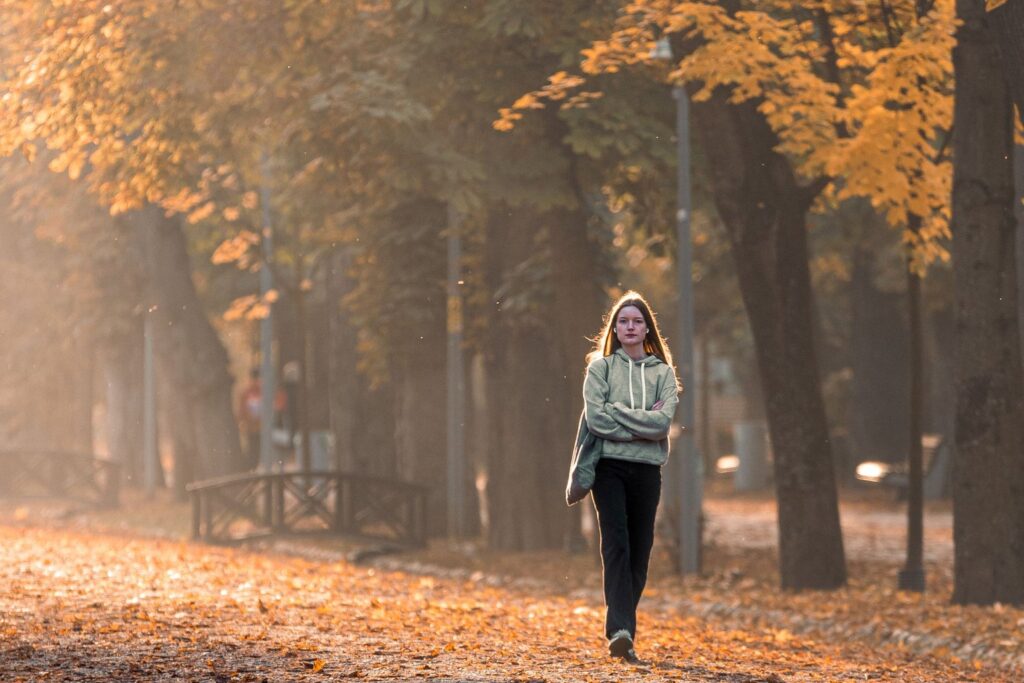
Before buying anything, understand the scale of indoor light. A well-lit office is somewhere around 500 lux. An overcast winter morning outdoors is several thousand. A bright day is tens of thousands. Your living room is not in the same category as stepping outside, whatever it looks like to your eyes, because your pupils adapt and hide the difference.
A morning walk is therefore the cheapest version of the same intervention, and it stacks: daylight, movement and a routine anchor at once. It will not be enough on its own for moderate or severe SAD, and for many people with the milder winter version it genuinely helps.
What Else Helps, and What Does Not
- Exercise. Worth doing for mood generally. Outdoors in the morning is the version that does two jobs at once.
- A regular wake time. SAD disturbs sleep timing, and a fixed start to the day steadies it. See our guide to sleep, magnesium and what actually works.
- Talking therapy. CBT adapted for SAD has decent evidence and, unlike a lamp, some of the benefit carries into later winters.
- Vitamin D is not a treatment for SAD. Worth correcting a common assumption. Low vitamin D is very common in winter and worth addressing for its own reasons, but it is not established as a treatment for seasonal depression. Our guide to vitamin D deficiency covers what it does and does not do.
- Antidepressants are a first-line option alongside light therapy, not a last resort or a failure. That is a decision for your GP.
Safety and Who Should Check First
- Bipolar disorder. Bright light can trigger a switch into mania or hypomania. This needs medical supervision, not a purchase.
- Eye conditions, including macular degeneration, retinal disease and diabetic retinopathy. Ask an ophthalmologist first.
- Photosensitising medication, including some antibiotics, St John’s wort, lithium, melatonin and certain acne treatments. Check with a pharmacist.
- Common mild effects are headache, eyestrain, nausea and feeling wired. These usually settle by moving the box further away or shortening the session.
- Buy a box intended for SAD, which should filter UV. Tanning lamps and general grow lights are not substitutes and can harm your eyes and skin.
If your mood is low enough that you are struggling to function, or you have thoughts of harming yourself, please contact your GP or NHS 111 now. In the UK you can call Samaritans free on 116 123 at any hour. Seasonal depression is still depression and deserves proper care.
Frequently Asked Questions
Does light therapy really work for SAD?
Yes. A 2024 meta-analysis of 21 randomised trials covering 1,037 people found phototherapy significantly more effective than control treatments, and reviewers describe it as a first-line non-drug option. The effects are described as mild to moderate and the evidence quality is not high, but the effect is real.
How long does a SAD lamp take to work?
Most people notice a change within one to two weeks of daily use, not on the first morning. If nothing has shifted after a fortnight of correct use, check the distance and the timing before concluding it does not work for you.
When should I use a light box?
Within the first hour after waking, for about 30 minutes at 10,000 lux. Evening use can shift your body clock the wrong way and disturb your sleep.
Is blue light better than white for SAD?
The evidence does not support paying more for it. A 2025 network meta-analysis of 17 studies ranked white light most effective, ahead of green, blue and red.
Do dawn simulators work as well as light boxes?
In a head to head trial they reduced depression scores by a similar amount, around 42% against 44%. People with more severe symptoms tended to do better with a bright light box, while dawn simulators suited those who found a light box inconvenient or hard on the eyes.
Will vitamin D help my seasonal depression?
It is not established as a treatment for SAD, despite being widely recommended for it. Correcting a genuine deficiency is worthwhile for other reasons, but do not expect it to do the job light therapy does.
Can I just use a bright normal lamp?
No. Ordinary room lighting is around 500 lux, a fraction of what the trials used, and household bulbs do not filter UV the way a purpose-built SAD box does.
Can light therapy be harmful?
It is generally well tolerated, with headache and eyestrain the usual complaints. It can trigger mania in people with bipolar disorder, and anyone with an eye condition or on photosensitising medication should take advice first.
Related Reading
- Vitamin D Deficiency, the other thing everyone blames on winter
- Magnesium for Sleep, and what the evidence says actually fixes insomnia
- Natural Immune Boosters for Winter
- Zinc for Colds
This article is for educational purposes only and is not medical advice. Seasonal affective disorder is a form of depression and should be assessed by a doctor. Do not start light therapy without medical advice if you have bipolar disorder, an eye condition, or take photosensitising medication, and never stop a prescribed antidepressant on your own. If you are struggling to cope or having thoughts of harming yourself, contact your GP or NHS 111, or call Samaritans free on 116 123 at any time. See our medical disclaimer.
Images by ysnapshotjournal, Ivan S, Jacoby Clarke, Filip Marcus Adam and Michael Pointner via Pexels (free licence).