
Ask which is better for you, Marmite or Vegemite, and the internet will tell you one is British and one is Australian, that they taste different, and that you grew up with whichever you prefer. All true. None of it answers the question.
So we did what we did with Marmite and Bovril: read the back of both jars and worked out what you get in the amount you actually eat.
The answer splits in two, and the split is cleaner than we expected. One of them is genuinely less salty. The other one has a vitamin the first one does not have at all.
The short answer
Vegemite is the less salty one. Marmite is the more fortified one. Which matters more depends entirely on you.
If you are watching your salt, Vegemite wins, although by less than the two labels make it look. If you are vegan or vegetarian, Marmite wins and it is not close, because Vegemite declares no vitamin B12 at all while one serving of Marmite carries 76 per cent of your daily reference intake.
Neither is gluten free. Both have a reduced salt version. And the serving sizes printed on the two jars are not the same, which is why most comparisons you will read are quietly wrong.
Where the figures come from
The Vegemite numbers below were read on 3 November 2026 from Bega’s own product page at vegemite.com.au, which prints the full Nutrition Information panel and states the serving size as 5 g. The allergen declaration was read the same day from the IGA listing for the 380 g jar, because the brand page does not print one.
The Marmite numbers are the label figures read on 29 October 2026 from Unilever’s published nutrition table, the same set used in our Marmite against Bovril comparison. Labels change, so check the jar in front of you rather than trusting any article, including this one.
One thing to check before you compare anything: which Marmite you have
There are two different products called Marmite, and they are not the same recipe. The one sold in the United Kingdom is Unilever’s, and its label figures are the ones used throughout this article. In New Zealand and Australia the jar on the shelf is usually Sanitarium’s Marmite, a separate product with its own formulation and its own panel.
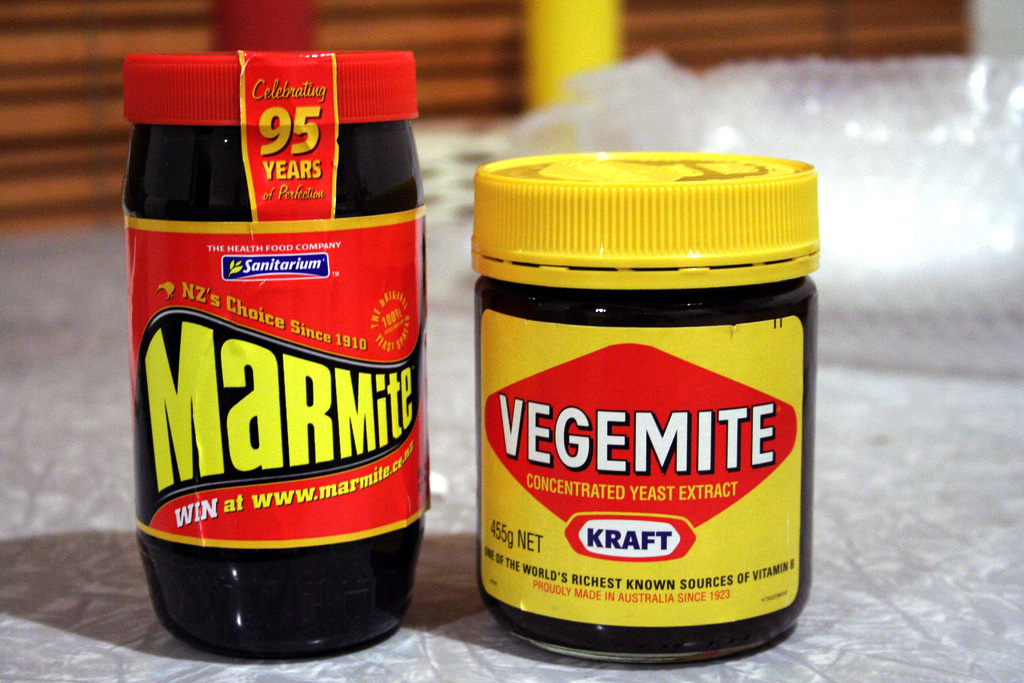
So if you are reading this in Auckland or Adelaide with a jar in your hand, check the maker on the label before you use the Marmite column below. The Vegemite figures are Australian and apply either way.
Per 100 grams, the fair footing
| Per 100 g | Vegemite | Marmite |
|---|---|---|
| Energy | 729 kJ, about 174 kcal | 260 kcal |
| Protein | 25.9 g | 34 g |
| Carbohydrate | 11.1 g, of which sugars 2.4 g | 30 g |
| Dietary fibre | 8.4 g | not stated on the table we read |
| Salt | about 8.25 g (sodium 3,300 mg) | 10.8 g |
This is the comparison that actually compares like with like, and it says three things. Vegemite is about a quarter less salty. Marmite is noticeably more energy dense and carries nearly three times the carbohydrate, which is where that energy comes from. Marmite has more protein.

Per the serving each jar declares, the gap looks bigger than it is
Here is the same comparison on each manufacturer’s own declared serving.
| Per declared serving | Vegemite, 5 g | Marmite, 8 g |
|---|---|---|
| Energy | 36 kJ, about 9 kcal | 21 kcal |
| Protein | 1.3 g | 2.7 g |
| Salt | about 0.41 g (sodium 165 mg, 7% DI) | 0.86 g (14% RI) |
| Thiamin, B1 | 0.55 mg, 50% | 56% |
| Riboflavin, B2 | 0.43 mg, 25% | 39% |
| Niacin, B3 | 2.5 mg, 25% | 34% |
| Folate | 100 µg, 50% | 100 µg, 50% |
| Vitamin B12 | none declared | 1.9 µg, 76% |
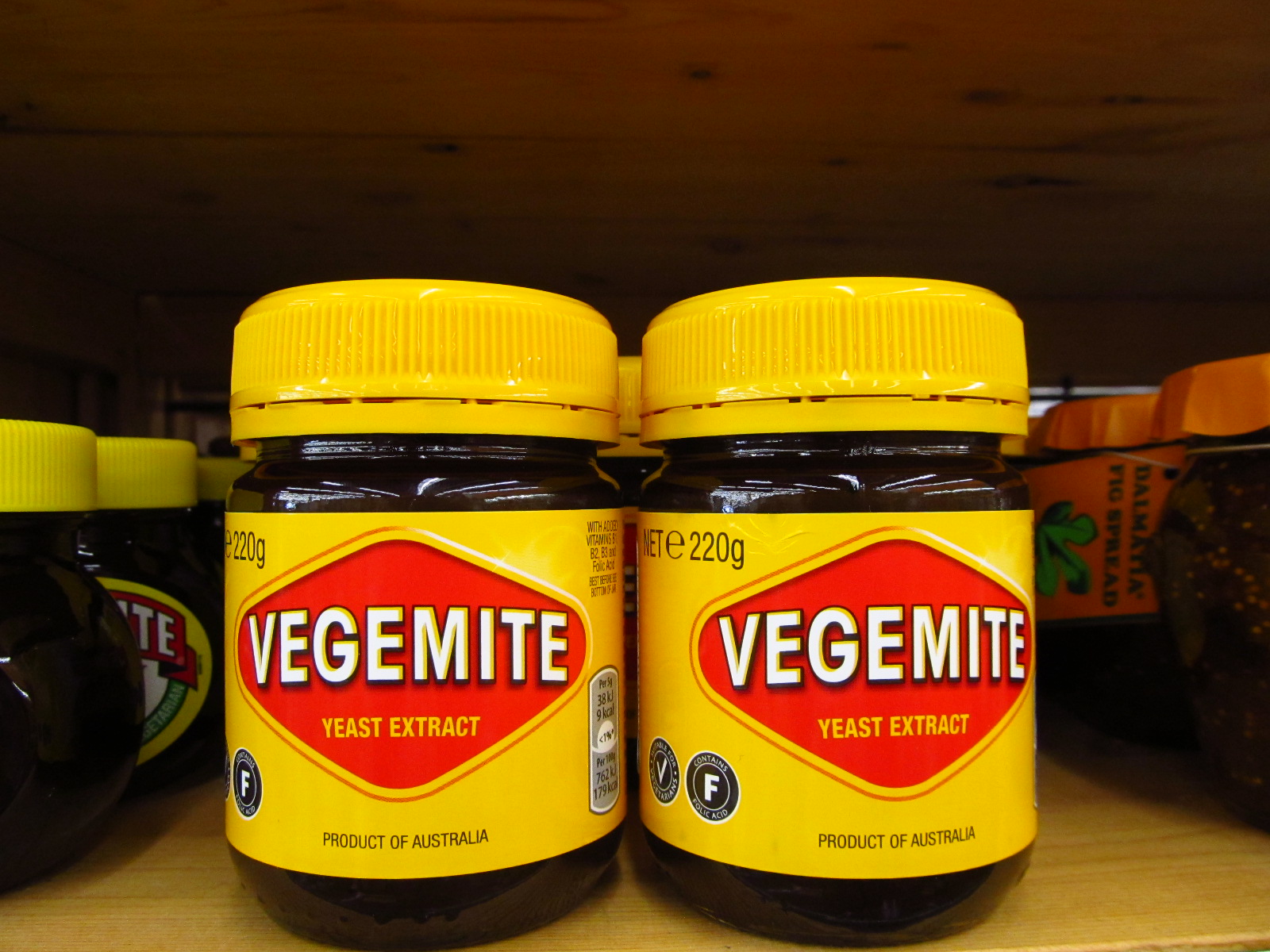
Read the salt row and Vegemite looks like it has less than half the salt of Marmite. It does not, and the reason is in the column headings. Vegemite’s declared serving is 5 grams and Marmite’s is 8.
Put the same weight on the toast and the picture changes. Eight grams of Vegemite carries about 0.66 g of salt against Marmite’s 0.86 g. So Vegemite really is the lower salt spread, by roughly 24 per cent, not by the 52 per cent the two labels suggest. Half of that apparent gap is a smaller spoon.
This is the same hidden variable we found between Marmite and Bovril, where Bovril’s larger declared serving made it look worse than its per 100 gram figures did. Here the trick runs the other way and flatters Vegemite. The fix is the same both times: when two labels disagree about serving size, compare per 100 grams first.
Worth saying plainly too: almost nobody measures 5 grams of anything at breakfast, and a generous scrape doubles every number in that table.
The B12 difference, which is the one that can actually matter
Bega’s own page states it in one sentence: “VEGEMITE contains vitamins B1, B2, B3 and folate.” B12 is not in that sentence and it is not in the panel. Marmite declares 1.9 µg per serving, 76 per cent of the daily reference intake.
For most people eating meat, fish, eggs or dairy, this is a detail. For a vegan or vegetarian reader it is the whole comparison. B12 comes almost entirely from animal foods or from fortification, and a 2025 systematic review and meta analysis of vegetarian and vegan Seventh Day Adventists found measurably lower serum B12 in both groups than in people who eat meat (PubMed 39136672).
If you are avoiding animal products and you like a savoury spread, Marmite does a job for you that Vegemite does not do. That is not a verdict on taste. It is what the two panels say.
Allergens: neither one is gluten free
Both products are built on yeast extract grown on grain, and both declare it. The IGA listing for Vegemite gives the declaration as “Allergen: Barley, Wheat”, with “Allergen may be present: Wheat, Gluten, Barley”, and the same wording appears on the 40 per cent less salt jar. Marmite declares barley, wheat, oat and rye.
So if you have coeliac disease, both of these are out. Read the jar rather than assuming the Australian one is different, because it is not, and take the ingredients list to your GP or dietitian rather than working from a comparison article if a reaction is the thing you are trying to avoid.
Both have a reduced salt jar, and that changes the answer
This is the part people miss, and it reopens the whole question.
Reduced salt Marmite carries 0.49 g of salt per 8 g serving, 8 per cent of the daily maximum, against 0.86 g for the classic jar. It also has slightly more protein at 3.1 g and slightly more B12 at 2 µg, 80 per cent of the reference intake. Less salt and more of everything else.
Vegemite 40% Less Salt exists too, in a 235 g jar, and the claim is in the product name rather than something we have read off a panel. Taken at face value, 40 per cent less than 165 mg of sodium per 5 g serving is about 99 mg, or roughly 0.25 g of salt. We have not read that panel at source, so treat that figure as arithmetic on the brand’s own claim and not as a label reading.
Put the two reduced salt jars side by side on the numbers we do have, and reduced salt Marmite still carries the B12 while the Vegemite still has the lower salt. The trade is the same one, in a narrower band.
Why the salt number is the one worth caring about
The NHS advises adults to eat no more than 6 grams of salt a day, and Australian guidance sits in the same region. Most people are over it before they add anything deliberately, because the salt is already in bread, cheese and sauces.
The evidence behind that advice is unusually consistent. A 2020 systematic review and meta analysis in the BMJ found a clear dose response between cutting sodium and lower blood pressure (PubMed 32094151), a 2021 dose response meta analysis in Circulation reached the same shape of answer (PubMed 33586450), and a 2025 umbrella review in Annals of Medicine linked higher intake to worse cardiovascular outcomes (PubMed 41243115).
None of which makes a scrape of either spread a problem. It means a daily habit of one costs you 7 per cent of your allowance and the other 14 per cent, on their own declared servings, and more than that if your scrape is generous.
Who should be more careful
- Anyone watching blood pressure. Vegemite is the lower salt option at equal weight, and the reduced salt version of either is a bigger change than switching brands.
- Anyone prone to gout. Both are concentrated yeast, and yeast is named among the most purine dense foods in an analysis of 270 foodstuffs in the Biological and Pharmaceutical Bulletin, which also notes Japanese guidance to keep dietary purines under 400 mg a day (PubMed 24553148).
- Coeliacs. Both declare grain allergens. Neither is an option.
- Vegans and vegetarians. Both are suitable, but only Marmite gives you B12.
- Anyone on a low sodium diet for kidney or heart reasons. Ask whoever is managing it before making either a daily habit.
The verdict
If the question is which tastes better, that is yours and no label will settle it.
If the question is which is better for you, the honest answer is that it depends on which problem you are solving, and both jars are more alike than the rivalry suggests.
Choose Vegemite if salt is your concern. It is genuinely lower at equal weight, by about a quarter, and lower still in the 40 per cent less salt jar.
Choose Marmite if you want the spread to do some nutritional work, and especially if you are vegan or vegetarian. The B12 is the one thing in this comparison that the other product does not offer at any serving size.
And whichever you pick, the reduced salt jar is the better version of it.
Frequently asked questions
Which has more salt, Marmite or Vegemite?
Marmite. Per 100 grams it is 10.8 g of salt against about 8.25 g for Vegemite. Per the serving each label declares the gap looks much bigger, 0.86 g against 0.41 g, but that is partly because Vegemite’s declared serving is 5 grams and Marmite’s is 8.
Is Vegemite healthier than Marmite?
On salt, yes. On vitamins, no. Marmite is fortified with B12 at 76 per cent of the daily reference intake per serving and Vegemite declares none, while Vegemite is about a quarter lower in salt at equal weight.
Does Vegemite have B12?
Not according to its label. Bega’s product page lists B1, B2, B3 and folate, and B12 does not appear in the panel. Marmite declares 1.9 µg per 8 gram serving.
Is either one gluten free?
No. Vegemite declares barley and wheat, and Marmite declares barley, wheat, oat and rye. Both come from yeast grown on grain.
Is Vegemite vegan?
Yes, and so is Marmite. Both are yeast extract rather than meat based, unlike Bovril, which is 58 per cent beef broth.
What is the difference in taste?
Marmite is sweeter and runnier, Vegemite saltier on the tongue and thicker, which is what the carbohydrate difference in the per 100 gram table would predict. Beyond that it is preference, and the labels have nothing to say about it.
Medical disclaimer
This article is general information about two food products and the figures printed on their labels. It is not medical advice, and nobody with a medical qualification has reviewed it. If you have high blood pressure, kidney disease, gout, coeliac disease or any condition that affects what you should eat, follow the advice of the clinician looking after you rather than anything written here. Labels and recipes change, so check the jar in front of you.
Vegemite panel and serving size read on 3 November 2026 from vegemite.com.au; Vegemite allergen declaration and the 40 per cent less salt jar read the same day from the IGA Shop Online listings. Marmite label figures read on 29 October 2026 from Unilever’s published nutrition table. Salt figures converted from sodium where a label gives sodium only.