
Quercetin is the hay fever supplement with the most convincing story and some of the thinnest human evidence. The best synthesis available, a 2025 systematic review in a mainstream allergy journal, pooled thirteen randomised trials and found that nasal symptom scores did improve, that quality of life scores did not, and that the certainty of the whole body of evidence was low to very low. On top of that, the two trials people cite for quercetin did not test the quercetin sold in most shops. They tested forms engineered to be absorbed. This page sets out what was actually measured, in whom, at what dose, and what that leaves you with if you are standing in front of a shelf of 500 mg capsules.
The Evidence at a Glance
| Study | What it tested | Dose and length | What it found |
|---|---|---|---|
| 2025 review and meta-analysis, 13 RCTs, 823 people | Polyphenols for allergic rhinitis, quercetin pooled with catechins | Varied | Nasal symptom scores improved (SMD 0.73). Quality of life did not. Certainty low to very low |
| 2009 cedar pollen trial, 20 people | Enzymatically modified isoquercitrin, a better absorbed form | 200 mg daily, 8 weeks, in season | Eye itching and total eye score improved. Nasal scores did not reach significance (p = 0.06) |
| 2022 trial, 66 people | Quercetin Phytosome, a formulation built for bioavailability | 200 mg daily, 4 weeks | Eye itching, sneezing, nasal discharge and sleep scores improved against placebo |
| 2025 animal review | Quercetin in animal models of allergy | Varied | Clear multi-target anti-allergic effects. Not human data |
| Head to head against an antihistamine | Nothing. No trial has been run | n/a | The comparison everyone wants does not exist in the literature |
The Short Answer
Quercetin probably takes the edge off nasal symptoms for some people with seasonal hay fever, by a modest amount, on evidence the reviewers themselves rate as low certainty. It is not an antihistamine substitute, nobody has tested it against one, and the quality of life measures in the pooled trials did not budge. If you want to try it, the form on the label matters more than the number of milligrams, and it needs several weeks before your season rather than a dose on a bad day. For where it sits against everything else, see our ranked guide to natural remedies for hay fever, where saline rinsing, not a supplement, is the best evidenced measure on the list.
What Quercetin Is, and What It Does in a Test Tube
Quercetin is a flavonol, one of the plant pigments in red onions, apples, capers, kale, berries and tea. In laboratory work it stabilises mast cells, the immune cells that dump histamine when they meet pollen, and it damps the signalling that follows. That is a genuinely good mechanism for an allergy, which is why the supplement industry found it, and it is also where most of the enthusiasm online comes from.
The mechanism evidence is strong. A 2025 systematic review and meta-analysis of preclinical studies found consistent multi-target anti-allergic effects across animal models, and a 2017 rat model of allergic rhinitis showed the same. Neither of those is a person with hay fever, and the gap between a mast cell in a dish and a nose in June is exactly where this story gets complicated.
The Human Trials, in Order of Weight
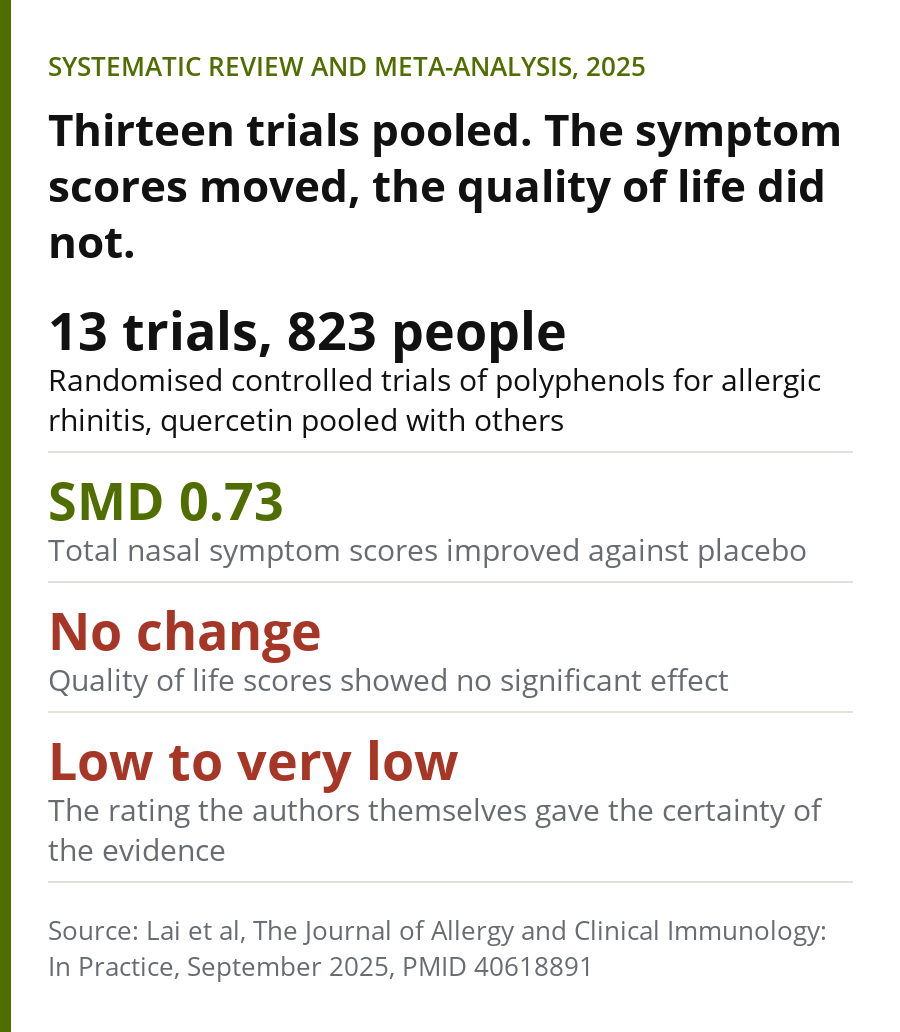
2025: thirteen trials pooled, and the finding nobody quotes
The strongest thing anyone can point to is a systematic review and meta-analysis published in The Journal of Allergy and Clinical Immunology: In Practice in September 2025. It gathered thirteen randomised controlled trials covering 823 people, seven with seasonal allergic rhinitis and six with the year round kind.
In seasonal allergic rhinitis, polyphenols reduced total nasal symptom scores with a standardised mean difference of 0.75, sneezing by 0.58 and nasal itching by 0.54. A more conservative analysis that dropped two outlier trials and combined the seasonal and perennial groups still found total nasal symptom scores down (SMD 0.73), along with nasal obstruction (0.50) and sneezing (0.57). Those are real effects, in the range a reader would notice.
Two things in the same paper get left out of almost every article about it. First, the authors rated the overall certainty of evidence for the main nasal outcomes as low to very low, because the trials disagreed with each other and carried a risk of bias. Second, the effects on quality of life were not statistically significant. Symptom scores moved. How people rated their lives did not. When a treatment shifts a score sheet without shifting how the season feels, that is worth knowing before you spend money on it.
There is one more honest caveat, and it is about quercetin specifically. This review pools polyphenolic compounds, quercetin together with catechins and others. It is not a quercetin only meta-analysis. The reason it has to pool them is that there are not enough quercetin trials to analyse on their own, which tells you as much as the effect size does.
2009: the trial where the eyes improved and the nose did not
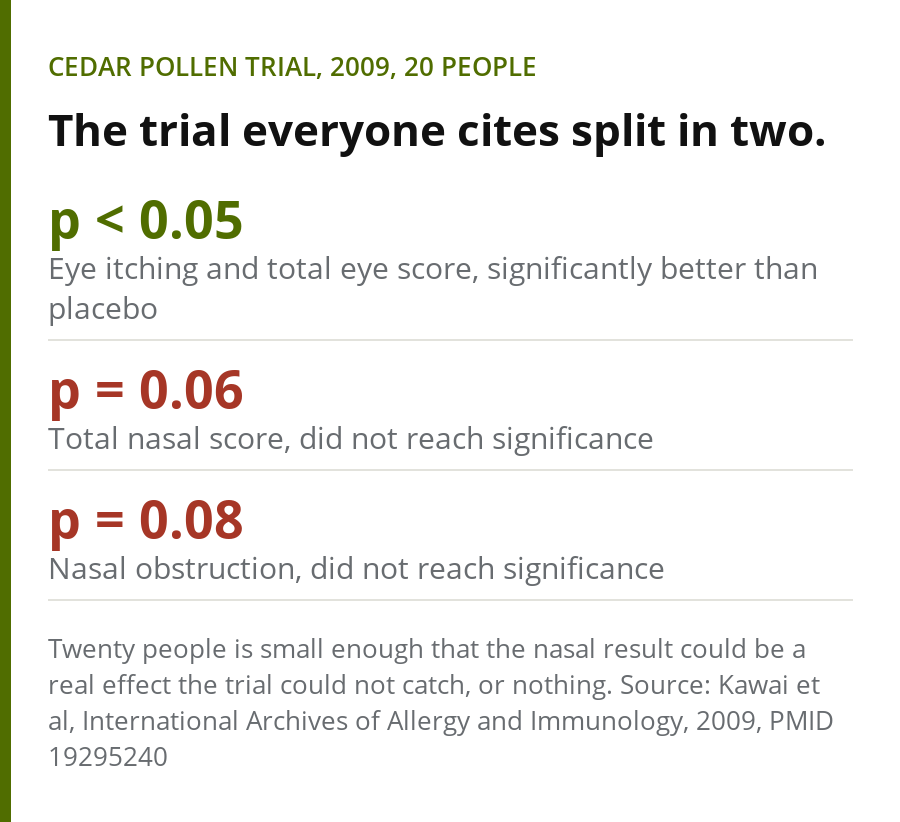
The trial most often cited as proof is a double blind, placebo controlled study published in the International Archives of Allergy and Immunology in 2009. Twenty people with Japanese cedar pollinosis took 100 mg of enzymatically modified isoquercitrin twice a day for eight weeks, through the pollen season, and recorded their symptoms daily.
Read the results closely and they split in two. Total eye score and eye itching were significantly lower than placebo across the whole study period, and a companion study found a preventive effect on eye symptoms too. The nose is a different story: total nasal score came in at p = 0.06 and nasal obstruction at p = 0.08, which means neither reached statistical significance. Total symptom score was significantly better only in weeks four and five.
So the trial behind most quercetin hay fever claims is a twenty person study that moved eye symptoms and missed on nasal ones. Twenty people is small enough that the nasal result could be a real effect the study was too small to catch, or nothing at all. The paper cannot tell you which, and neither can anybody citing it.
2022: a bioavailable form, sixty six people, four weeks
The newest individual trial is a 2022 randomised, placebo controlled, double blind study of 66 Japanese adults aged 22 to 78 with pollen allergy symptoms. They took 200 mg of quercetin daily for four weeks. Scores on a validated rhinoconjunctivitis quality of life questionnaire improved against placebo for eye itching, sneezing, nasal discharge and sleep disturbance.
This is the most encouraging single result in the set, and the detail that matters is in the methods rather than the findings. The product tested was Quercetin Phytosome, a formulation developed specifically to get more quercetin into the bloodstream. That is not a criticism of the trial. It is the reason the next section exists.
Three Doses That All Read as 200 mg
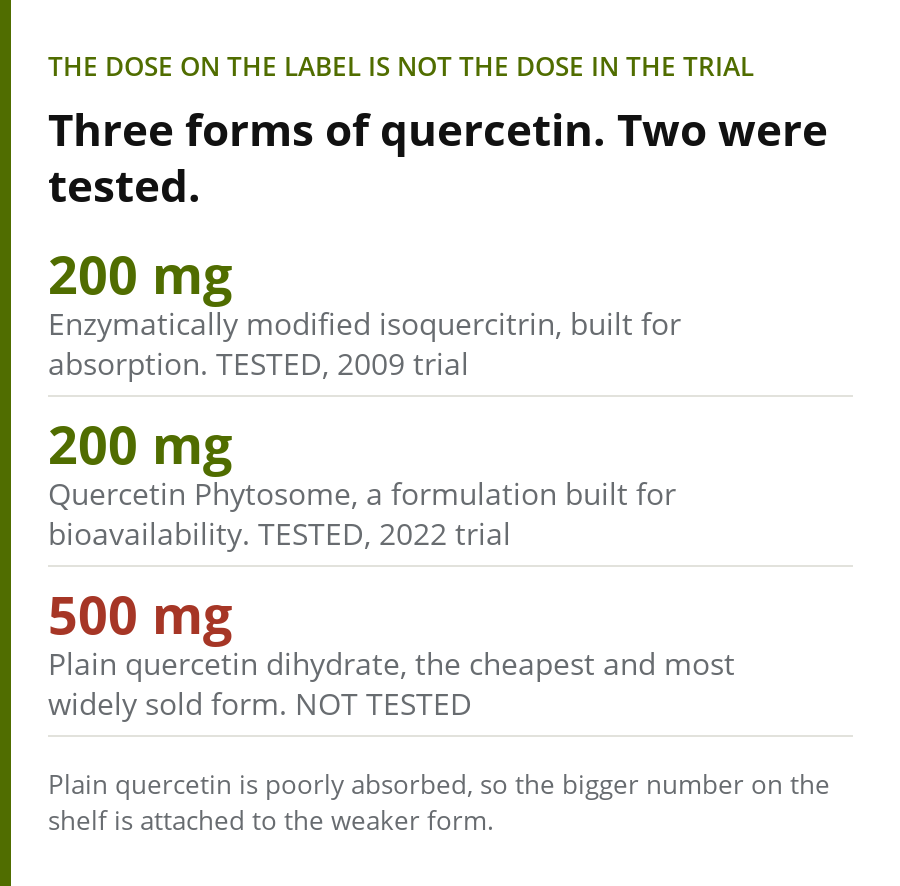
Plain quercetin is poorly absorbed. Swallowed as the loose powder in a capsule, most of it never reaches your blood, which is the reason the supplement industry kept building modified versions of it. Both human trials above used one of those modified versions.
- Enzymatically modified isoquercitrin (EMIQ), 200 mg a day. Engineered for absorption. This is the 2009 cedar pollen trial.
- Quercetin Phytosome, 200 mg a day. A lecithin based formulation built for bioavailability. This is the 2022 trial.
- Plain quercetin dihydrate, commonly 500 mg a capsule. The cheapest and most widely sold form, and the one the trials did not test.
Which means the bigger number on the shelf is attached to the weaker form, and three doses that all look like “quercetin, a couple of hundred milligrams” are not interchangeable. If you decide to try quercetin on the back of those trials, the thing to match is the form, not the milligram count. A label that names EMIQ, isoquercitrin or a phytosome or lecithin formulation is the one carrying the evidence. A label that just says quercetin at a bigger number is not the same product, however much more of it you are being sold.
Could You Just Eat It Instead?
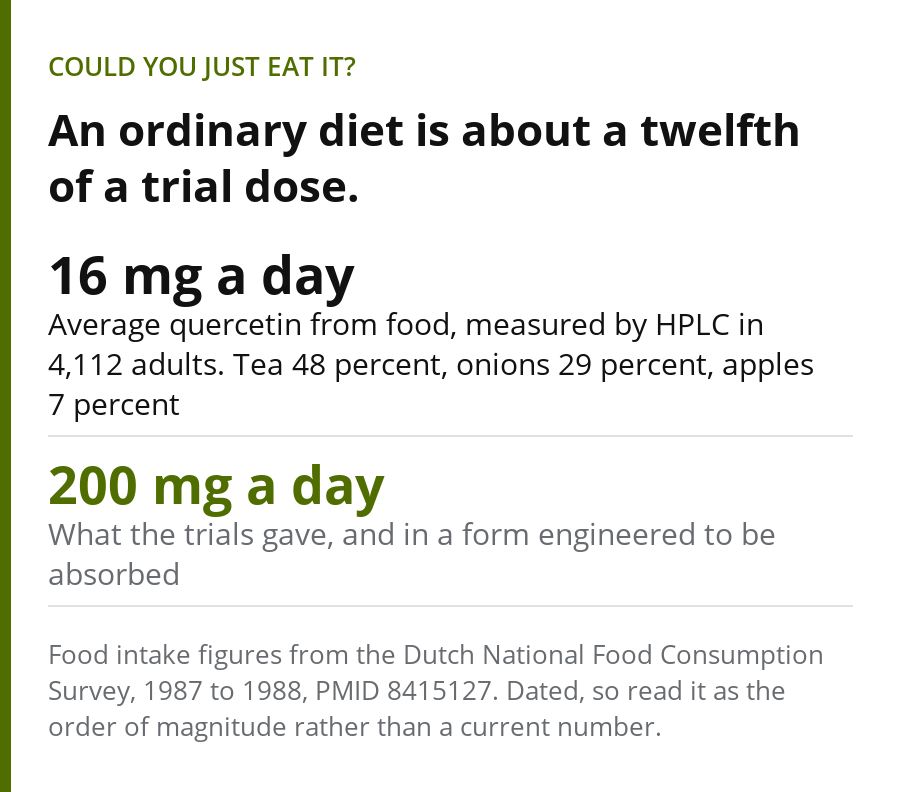
This is the fair question, and the arithmetic answers it. The classic measurement comes from the Dutch National Food Consumption Survey, which used HPLC testing of foods to work out what 4,112 adults were actually getting. Average intake of all flavonoids combined was 23 mg a day, of which quercetin was about 16 mg. Tea supplied 48 percent of it, onions 29 percent and apples 7 percent.
That survey ran in 1987 and 1988, so treat it as the right order of magnitude rather than a current figure. The order of magnitude is the whole point: an ordinary diet delivers something like 16 mg of quercetin a day, in the poorly absorbed form, against 200 mg a day of an absorbable form in the trials. Eating more onions and apples is a good idea for a dozen other reasons, and our guide to anti-inflammatory foods covers them, but it will not get you to a trial dose. Nobody has tested a high quercetin diet against hay fever either, so the food route is unmeasured rather than disproven.

Quercetin Against an Antihistamine: the Trial Nobody Has Run
People ask whether quercetin can replace cetirizine or loratadine, and the straight answer is that no study has compared them. We searched the medical literature for a head to head trial of quercetin against an antihistamine in allergic rhinitis and there is not one. Every trial above measures quercetin against a placebo, which tells you whether it does something, not whether it does as much.
What can be said is indirect and it still points one way. Antihistamines are licensed medicines with large trials behind them and a known effect on sneezing, itching and runny nose. Quercetin has thirteen pooled trials of mixed quality, a modest effect on symptom scores, no effect on quality of life and a certainty rating of low to very low. Treating them as alternatives is not something the evidence supports, and if an antihistamine is keeping your season bearable, swapping it for a supplement is a decision to take with the person who prescribed it rather than on your own.
Taking both is a different question, and also one for a pharmacist, because quercetin interacts with more medicines than people expect. That is the next section.
Who Should Leave It Alone
- Pregnancy and breastfeeding. Not established as safe at supplement doses. Leave it.
- Anyone on blood thinners. Check with a pharmacist before starting.
- Anyone on antibiotics, ciclosporin or other medicines processed by the liver. Quercetin can change how fast some drugs are cleared, which changes the dose you are effectively getting.
- Children. The trials were in adults. There is no paediatric dose to copy.
- Anyone with kidney problems. Discuss it first rather than taking high doses on your own.
Food quantities of quercetin are not the concern here. Concentrated supplement doses are, and the interaction risk is the reason a pharmacist is worth a two minute question before you start. Read our medical disclaimer: this is general information, not advice about your own case.
If You Are Going to Try It
None of the following is a recommendation to take quercetin. It is what the trials did, so that anyone who has decided to try it is at least copying the thing that was measured.
- The trials ran 200 mg a day of an absorbable form, not 500 mg of plain powder.
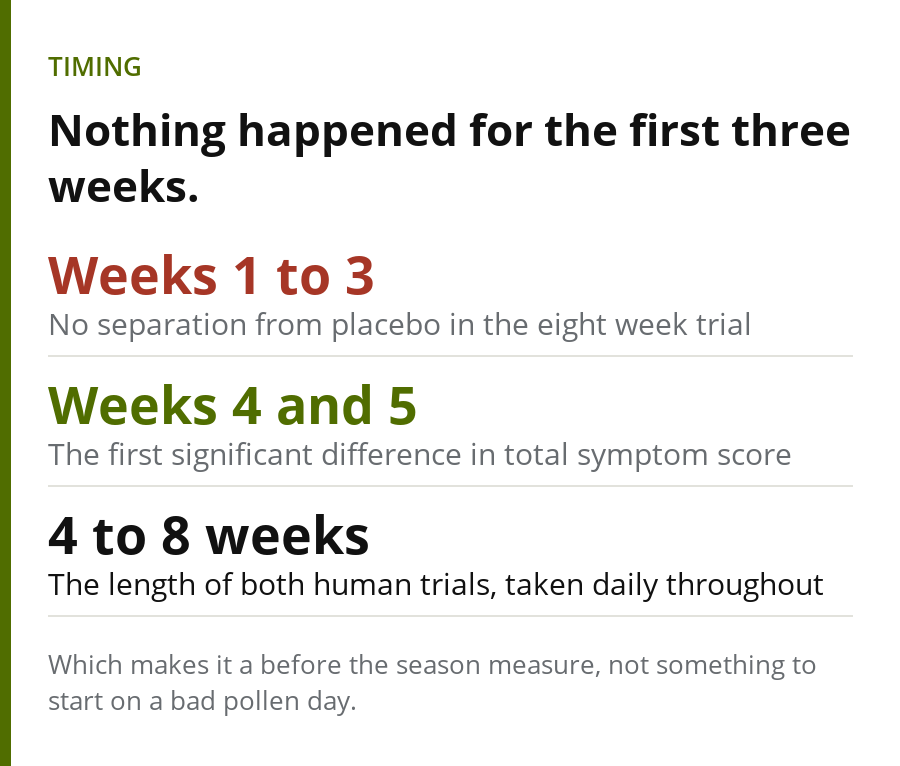
- They ran for four to eight weeks, and the 2009 trial only separated from placebo around weeks four and five. Starting it on a bad pollen day is not what was tested.
- The clearest effects in both trials were on eye symptoms. If your worst symptom is a blocked nose, the evidence for that specifically is the weakest part of the picture.
- It was taken alongside normal treatment in the trial designs, not instead of it.
- Ask a pharmacist first if you take any regular medicine.
And set it against the alternatives before you spend anything. On the ranked evidence in our hay fever guide, saline nasal rinsing has multiple meta-analyses behind it and costs almost nothing, which makes it a better first move than any supplement on the shelf.
When to See a Doctor
See a doctor if your symptoms are not controlled by over the counter treatment, if you are wheezing or short of breath, if symptoms last all year rather than through a season, or if you are considering stopping a prescribed medicine. Hay fever that is bad enough to disrupt sleep or work has treatment options well beyond a supplement, including prescription nasal steroids and immunotherapy, and a supplement is not the thing to try instead of asking.
Frequently Asked Questions
Does quercetin actually work for hay fever?
Modestly, on weak evidence. A 2025 meta-analysis of thirteen trials found nasal symptom scores improved, quality of life scores did not, and the certainty of the evidence was rated low to very low. It is not nothing, and it is not an antihistamine.
How much quercetin should I take for hay fever?
The trials used 200 mg a day, but of forms built for absorption rather than the plain quercetin most capsules contain. There is no established dose for hay fever, and this is a question for a pharmacist if you take any other medicine.
How long does quercetin take to work for allergies?
Weeks, not hours. The eight week cedar pollen trial only showed a clear difference from placebo around weeks four and five, and the other trial ran for four weeks. It is a before the season measure, not a rescue one.
Is quercetin better than an antihistamine?
Nobody has tested that. No trial has compared quercetin head to head against an antihistamine for allergic rhinitis. Antihistamines have far larger and better quality evidence behind them.
Can I get enough quercetin from onions and apples?
No. An ordinary diet supplies roughly 16 mg of quercetin a day in the poorly absorbed form, against 200 mg a day of an absorbable form in the trials. Eating those foods is worthwhile for other reasons, but it is not a trial dose.
Can I take quercetin with my antihistamine?
In the trials quercetin was taken alongside normal treatment rather than instead of it, but quercetin interacts with several medicines, so ask a pharmacist about your own combination.
Related Guides
- Natural remedies for hay fever, ranked by evidence
- Anti-inflammatory foods
- How to use a neti pot safely